
Dependent clause examples form the bedrock of sophisticated writing, allowing for nuanced expression and complex thought articulation. Understanding these clauses, which hinge on their independent counterparts for complete meaning, is crucial for crafting sentences that resonate with precision and impact. This exploration delves into the anatomy of dependent clauses, examining their various forms and functions within the intricate architecture of the English language. From noun clauses acting as sentence subjects to adverbial clauses adding temporal depth, we’ll uncover the versatility of these essential grammatical components.
We’ll then move to how to identify these clauses, exploring their role in compound-complex sentences, and finally the common pitfalls and nuances of placement and their impact on meaning. By dissecting the common errors and exploring strategic placement, this guide aims to equip you with the knowledge to wield dependent clauses with confidence and finesse, transforming your writing from basic to brilliant.
Understanding the Fundamental Nature of Dependent Clauses and Their Roles in Sentence Construction is essential for clear communication.
Understanding dependent clauses is fundamental to crafting clear and concise written communication. These clauses, unlike their independent counterparts, cannot stand alone as complete sentences. They rely on an independent clause to convey a full thought. Mastering the nuances of dependent clauses allows writers to build complex and sophisticated sentences, adding depth and precision to their expression. This understanding is particularly critical in professional settings where clarity and accuracy are paramount.
Defining Characteristics of Dependent Clauses
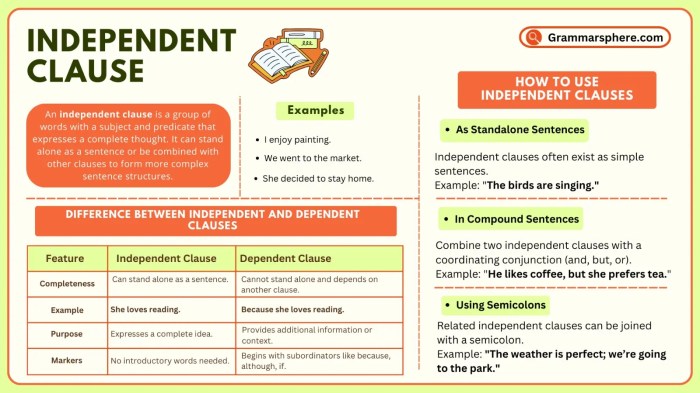
A dependent clause, also known as a subordinate clause, is a group of words that contains a subject and a verb, but it does not express a complete thought. It is “dependent” because it relies on an independent clause to make sense. Independent clauses, conversely, can stand alone as complete sentences. The key difference lies in their ability to function independently.
Several key characteristics distinguish dependent clauses: they begin with a subordinating conjunction (e.g., *because, although, if, when*) or a relative pronoun (e.g., *who, which, that*); they provide additional information about the main idea expressed in the independent clause; and they cannot function as a complete sentence on their own. For example, consider the sentence: “Because the meeting was cancelled, the team was notified.” The dependent clause, “Because the meeting was cancelled,” provides the reason for the action in the independent clause, “the team was notified.” Without the independent clause, the dependent clause would leave the reader with an incomplete thought. In contrast, the independent clause could stand alone: “The team was notified.” The presence of a subordinating conjunction, like “because,” signals the clause’s dependency. The relationship between these clauses shapes the meaning of the overall sentence. Understanding this relationship is key to constructing well-formed sentences that communicate effectively.
Functions of Dependent Clauses
Dependent clauses serve various grammatical functions within a sentence, acting as nouns, adjectives, or adverbs. Their role is determined by how they modify or contribute to the independent clause.
A dependent clause can function as a noun. For instance, in the sentence “What she said was surprising,” the dependent clause “What she said” acts as the subject of the sentence. It replaces a single-word noun, demonstrating the clause’s ability to take the place of a noun in the sentence’s structure.
Dependent clauses can also function as adjectives, modifying a noun or pronoun. Consider the sentence: “The book that I borrowed is interesting.” The dependent clause “that I borrowed” describes the noun “book,” providing more specific information about which book is being discussed. This functions similarly to a single-word adjective, clarifying the noun’s identity or characteristics.
Finally, dependent clauses can act as adverbs, modifying a verb, adjective, or another adverb. For example, in the sentence “He left after the movie ended,” the dependent clause “after the movie ended” modifies the verb “left,” providing information about when the action occurred. This functions like a single-word adverb, giving the time, place, or manner of the action. Understanding these different functions is crucial for sentence construction.
Subordinating Conjunctions and Their Functions
Subordinating conjunctions are essential for introducing dependent clauses and indicating the relationship between the dependent clause and the independent clause. These words signal the type of relationship the clause has with the main part of the sentence. The following bullet points illustrate some common subordinating conjunctions and their functions.
- Time: These conjunctions indicate when something happens.
- *after* (e.g., “After the rain stopped, we went outside.”)
- *before* (e.g., “Before you leave, please lock the door.”)
- *when* (e.g., “When I arrived, the party was already in full swing.”)
- *while* (e.g., “While I was studying, the phone rang.”)
- *until/till* (e.g., “We waited until the sun set.”)
- *since* (e.g., “Since she left, things have been different.”)
- *as* (e.g., “As the day went on, the weather improved.”)
- Reason/Cause: These conjunctions explain why something happens.
- *because* (e.g., “He was late because he missed the bus.”)
- *since* (e.g., “Since it was raining, we stayed inside.”)
- *as* (e.g., “As he was tired, he went to bed early.”)
- Condition: These conjunctions introduce a condition upon which something depends.
- *if* (e.g., “If it rains, we will stay home.”)
- *unless* (e.g., “Unless you study, you won’t pass the exam.”)
- *provided that/providing that* (e.g., “Provided that you finish your work, you can go out.”)
- *as long as* (e.g., “You can borrow the car as long as you drive carefully.”)
- Contrast/Concession: These conjunctions show a contrast or concession.
- *although/though* (e.g., “Although it was cold, we went swimming.”)
- *even though* (e.g., “Even though she was tired, she kept working.”)
- *while* (e.g., “While I agree with your point, I have another perspective.”)
- Purpose: These conjunctions indicate the reason for an action.
- *so that* (e.g., “I saved money so that I could buy a new car.”)
- *in order that* (e.g., “She studied hard in order that she could pass the test.”)
Identifying the Common Types of Dependent Clauses through Real-World Examples enhances one’s ability to construct grammatically sound sentences.
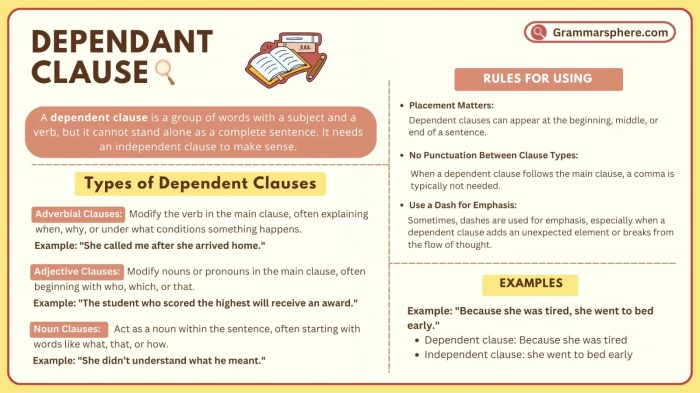
Understanding and correctly applying dependent clauses is a cornerstone of clear and effective written communication. These clauses, unable to stand alone as complete sentences, rely on independent clauses for their meaning. Mastering their different types and functions is crucial for crafting complex and nuanced sentences, avoiding ambiguity, and ensuring grammatical accuracy. This section delves into the three primary types of dependent clauses, providing examples to illustrate their practical application.
Dependent clauses, essential for constructing complex sentences, can be categorized into three main types based on their function within the sentence. Each type plays a distinct role, contributing to the overall meaning and structure. Recognizing these types allows writers to vary sentence structure and express ideas with greater precision.
The Three Main Types of Dependent Clauses
The three main types of dependent clauses are noun clauses, adjective clauses, and adverbial clauses. Each serves a specific grammatical function within a sentence, similar to how nouns, adjectives, and adverbs function individually. Recognizing the role each clause plays is key to understanding sentence structure and meaning.
- Noun Clauses: These clauses function as nouns, meaning they can act as subjects, objects, or complements within a sentence. They answer the questions “what?” or “who?” Consider the example: “What she said surprised everyone.” In this sentence, the noun clause “What she said” is the subject of the verb “surprised.”
- Adjective Clauses: Also known as relative clauses, these clauses modify nouns or pronouns, providing additional information about them. They answer the question “which one?” or “what kind?” For instance: “The book that I borrowed is overdue.” Here, the adjective clause “that I borrowed” modifies the noun “book.”
- Adverbial Clauses: These clauses function as adverbs, modifying verbs, adjectives, or other adverbs. They provide information about time, place, reason, purpose, condition, concession, or result. They answer questions like “when?” “where?” “why?” or “how?” An example is: “Because it was raining, we stayed inside.” In this case, the adverbial clause “Because it was raining” explains the reason for staying inside.
Exploring the Usage of Dependent Clauses in Complex and Compound-Complex Sentences showcases sentence-building mastery.
Mastering the art of incorporating dependent clauses is a cornerstone of sophisticated writing. It allows for the creation of complex and compound-complex sentences, enabling writers to express nuanced ideas and relationships between thoughts. These sentence structures provide the flexibility to convey intricate information in a clear and organized manner, demonstrating a command of grammar that elevates the quality of communication.
Dependent Clauses’ Contribution to Sentence Complexity
Dependent clauses are essential building blocks in crafting complex and compound-complex sentences, contributing significantly to their complexity. They function as subordinate elements, adding layers of meaning and relationships to the main clause.
Complex sentences contain one independent clause and at least one dependent clause. The dependent clause modifies the independent clause, providing additional information about time, place, reason, condition, concession, or purpose. For example: “Because the market was volatile, investors hesitated.” Here, “Because the market was volatile” is the dependent clause, providing the reason for the investors’ hesitation.
Compound-complex sentences, the most intricate type, consist of at least two independent clauses and one or more dependent clauses. They allow writers to combine multiple ideas with varying levels of importance and relationships. Consider this example: “Although the company reported record profits, the stock price remained stagnant, because investors were concerned about future growth.” This sentence has two independent clauses (“the stock price remained stagnant” and “the company reported record profits”) and one dependent clause (“Although the company reported record profits”), showcasing a complex relationship. Another example: “The meeting was cancelled after the manager fell ill, and the team rescheduled it for next week.” Here, the sentence features two independent clauses (“The meeting was cancelled” and “the team rescheduled it for next week”) and a dependent clause (“after the manager fell ill”).
Different types of dependent clauses, such as adjective, adverbial, and noun clauses, can be incorporated to create a variety of sentence structures. Adjective clauses modify nouns or pronouns, while adverbial clauses modify verbs, adjectives, or other adverbs, and noun clauses function as nouns within the sentence. The strategic use of these clauses allows writers to create sentences that are both informative and engaging.
Examining the Common Errors in the Use of Dependent Clauses will improve grammatical precision.
Mastering dependent clauses is crucial for clear and effective communication. However, even experienced writers can stumble, leading to grammatical errors that obscure meaning and detract from the overall quality of their work. Understanding these common pitfalls, such as comma splices, fused sentences, and misplaced clauses, is the first step towards achieving grammatical precision. By recognizing these errors and learning how to correct them, writers can significantly improve the clarity and impact of their writing.
Identifying Common Errors in Dependent Clause Usage
Several common errors frequently arise when working with dependent clauses. These mistakes often stem from a misunderstanding of how dependent clauses function within sentences, leading to structural flaws that disrupt the flow and clarity of the writing.
- Comma Splices: This error occurs when a comma is used to join two independent clauses without a coordinating conjunction. Often, a dependent clause is incorrectly joined to an independent clause using only a comma, creating a run-on sentence. For example: “I went to the store, because I needed milk.”
- Fused Sentences: Also known as run-on sentences, fused sentences occur when two independent clauses are joined without any punctuation or conjunction. A dependent clause can contribute to this error if it’s incorrectly positioned, making the sentence structure unclear. For example: “She enjoys reading novels she finds them to be very relaxing.”
- Misplaced or Dangling Modifiers: Misplaced modifiers, including dependent clauses, are positioned in a way that creates ambiguity about which word or phrase they are modifying. Dangling modifiers, on the other hand, do not clearly modify any word in the sentence. For example: “Having finished the report, the coffee was cold.” (Dangling modifier). Or: “Because he was tired, the dog’s nap was disturbed by the loud noise.” (Misplaced Modifier – the dependent clause incorrectly modifies “the dog’s nap”).
Guidelines for Avoiding Errors in Dependent Clause Usage
Avoiding these errors requires a conscious effort to understand the structure of sentences and the role of dependent clauses. Implementing a few key strategies can significantly improve grammatical accuracy and clarity.
- Recognize Independent and Dependent Clauses: The first step is to accurately identify independent and dependent clauses. An independent clause can stand alone as a complete sentence, while a dependent clause cannot. Understanding this distinction is crucial for proper punctuation and sentence construction.
- Use Coordinating Conjunctions Correctly: When joining two independent clauses, use a comma followed by a coordinating conjunction (for, and, nor, but, or, yet, so). For example: “I wanted to go to the beach, but it started raining.”
- Employ Appropriate Punctuation: If a dependent clause comes before an independent clause, separate them with a comma. For example: “Because it was raining, I stayed inside.” If a dependent clause follows an independent clause, a comma is often, but not always, necessary. The comma’s use depends on the clause’s essentiality to the sentence’s meaning.
- Check Modifier Placement: Ensure that modifying phrases, including dependent clauses, are placed as close as possible to the words they modify. If a modifier is placed incorrectly, the sentence’s meaning can become unclear.
- Revise and Edit: Always review your writing to catch any errors. Reading your work aloud can help you identify awkward phrasing or sentence structure problems. Using grammar-checking software can also be a helpful tool.
Demonstrating the Use of Blockquotes with Examples
The following examples demonstrate how incorrect dependent clause usage can lead to grammatical errors, along with the corrected versions and explanations.
Incorrect: Although he was tired, he decided to keep working, he needed to finish the project.
Correct: Although he was tired, he decided to keep working because he needed to finish the project.
Explanation: The original sentence contains a comma splice. The corrected version uses “because” to create a complex sentence, properly connecting the dependent and independent clauses.
Incorrect: She went to the park, because she wanted to see the flowers.
Correct: She went to the park because she wanted to see the flowers.
Explanation: The original sentence features a comma splice. Removing the comma creates a grammatically correct sentence.
Incorrect: The movie, which was very long, it was still enjoyable.
Correct: The movie, which was very long, was still enjoyable.
Explanation: The original sentence incorrectly uses “it.” The corrected version removes the redundant pronoun, creating a grammatically sound sentence.
Incorrect: After the game ended, the players celebrated the victory.
Correct: After the game ended, the players celebrated their victory.
Explanation: The original sentence is correct. However, adding “their” makes it more descriptive.
Incorrect: Because it was raining cats and dogs the game was cancelled.
Correct: Because it was raining cats and dogs, the game was cancelled.
Explanation: The original sentence omits the comma after the introductory dependent clause. The corrected version includes the comma, improving readability and grammatical correctness.
Exploring the Subtleties of Dependent Clause Placement and Its Impact on Meaning will improve the precision of written expression.
The placement of dependent clauses within a sentence is a subtle but powerful tool for shaping meaning and controlling the reader’s focus. Mastering this aspect of sentence construction allows writers to create sentences that are not only grammatically correct but also stylistically effective, guiding the reader through the information in a clear and compelling manner. Careful consideration of clause placement can significantly enhance the impact of your writing.
Impact of Dependent Clause Placement
The position of a dependent clause in a sentence significantly influences the emphasis and flow of the text. Placing the clause at the beginning, middle, or end of the sentence subtly alters the reader’s interpretation and the rhythm of the writing.
Placing a dependent clause at the beginning of a sentence, such as “Because the market crashed,” immediately establishes the context or reason for the main clause that follows. This structure creates anticipation and often highlights the cause-and-effect relationship. For instance, consider the sentence: “Because the market crashed, investors panicked.” The reader’s attention is immediately drawn to the market crash as the primary reason for the investors’ reaction.
In contrast, inserting a dependent clause in the middle of a sentence, as in “The company, which had been struggling for years, finally declared bankruptcy,” can provide additional information or a qualification. This placement often interrupts the flow, drawing attention to the inserted clause while still maintaining the primary focus on the main clause. The emphasis here is on the company’s long-term struggles as a contributing factor to its bankruptcy.
Finally, positioning the dependent clause at the end of the sentence, such as “The CEO resigned after the scandal was revealed,” provides a sense of closure or a concluding explanation. This structure allows the writer to build suspense or delay the most important information until the end, creating a climactic effect. The reader anticipates the outcome, and the dependent clause offers the resolution or consequence of the main action. This structure emphasizes the impact of the scandal on the CEO’s decision.
Restrictive vs. Nonrestrictive Clauses
The distinction between restrictive and nonrestrictive clauses is crucial for accurate and nuanced communication. Understanding the difference and using appropriate punctuation is essential for conveying the intended meaning.
Restrictive clauses, also known as essential clauses, are critical to the meaning of the main clause. They provide information that defines or limits the noun they modify. Removing a restrictive clause would change the core meaning of the sentence. These clauses are *not* set off by commas. For example, in the sentence “The employees who completed the training received a bonus,” the clause “who completed the training” is restrictive because it identifies *which* employees received the bonus. Without this clause, the sentence would not specify the criteria for receiving the bonus.
Nonrestrictive clauses, or non-essential clauses, provide additional information that is not critical to the sentence’s core meaning. They offer extra details about a noun but are not necessary to identify it. These clauses are set off by commas. Consider the sentence: “John Smith, who is the CEO, announced the new policy.” The clause “who is the CEO” is nonrestrictive because it simply adds extra information about John Smith; the core meaning of the sentence is still understandable without this clause. The use of commas indicates that the information is supplementary.
The punctuation difference is key. Restrictive clauses use no commas, while nonrestrictive clauses are always enclosed in commas. This punctuation difference is a direct indicator of the clauses’ function and impact on meaning. The use of “that” is typically associated with restrictive clauses, while “which” is typically associated with nonrestrictive clauses, though this is not a hard and fast rule.
Varying Sentence Structure through Dependent Clause Placement
Strategic placement of dependent clauses can significantly enhance readability and style. This section provides a guide to varying sentence structure through the strategic placement of dependent clauses, offering examples to demonstrate the effects of each technique.
- Beginning with a Reason/Cause: Starting a sentence with a dependent clause expressing reason or cause establishes context immediately.
- Example: “Because interest rates rose sharply, the housing market slowed.”
- Adding Information with an Appositive Clause: Use an appositive clause (nonrestrictive) to provide extra detail about a noun, placed after the noun it modifies.
- Example: “The new product, which had been in development for two years, was finally launched.”
- Emphasizing a Condition: Place a conditional clause at the beginning or end to highlight the importance of a specific condition.
- Example: “If the company meets its quarterly goals, employees will receive bonuses.”
- Creating Contrast with a Concessive Clause: Use a concessive clause (often starting with “although” or “though”) to introduce a contrast or unexpected outcome.
- Example: “Although the economy was weak, the company reported record profits.”
- Adding Descriptive Detail: Insert a relative clause (restrictive or nonrestrictive) to describe a noun, providing additional information.
- Example: “The building, which was designed by a renowned architect, is a landmark.” (Nonrestrictive)
- Example: “The books that were published last year are on sale.” (Restrictive)
- Building Suspense with End-Placement: Placing a dependent clause at the end of a sentence can create suspense or emphasize a consequence.
- Example: “The investigation revealed that the CEO had been involved in fraudulent activities.”
- Providing Background Information: Use a dependent clause to provide background information or set the scene.
- Example: “Before the meeting began, the team reviewed the project’s progress.”
- Adding Clarification: Place a dependent clause to clarify a previous statement.
- Example: “He decided to resign, because he felt his reputation was damaged.”
- Creating a Complex Sentence: Combine multiple dependent clauses with independent clauses to create complex sentences.
- Example: “While the market fluctuated, which caused uncertainty, investors remained cautious, because they feared further losses.”
- Using Parallel Structure: Ensure that dependent clauses are used in parallel structure when multiple clauses perform the same function.
- Example: “The company announced that it would expand its operations and that it would hire new employees.”
Outcome Summary
In conclusion, the journey through dependent clause examples highlights their indispensable role in shaping clear, compelling prose. From the fundamental distinctions between independent and dependent clauses to the subtleties of placement and punctuation, mastering these grammatical elements unlocks a world of expressive possibilities. By understanding and applying the principles discussed, writers can elevate their craft, crafting sentences that not only convey information but also captivate and engage the reader. The ability to manipulate dependent clauses is not just a grammatical skill; it’s a key to unlocking the full potential of written communication.
